
Hi! I am an applied microeconomist, and a PhD candidate at UC Davis. My research has two broad focuses. The first examines how individuals in rural, resource-dependent communities insure themselves against environmental risk. The second examines how infrastructure investment helps individuals more efficiently use resource endowments to improve their lives.
In my job market paper, I study how environmental risk shapes rural-urban migration decisions, and show how financial constraints can severely restrict rural communities’ ability to adapt to negative shocks. I also have work on the role of electrification in US rural development, price sensitivity in disaster insurance markets, and non-market valuation of water quality.
I am on the job market in the 2026-2027 academic year. Please click here to view my CV.
Research in Progess
- Climate Migration and Liquidity Constraints: Evidence from the Alaska Permanent Fund Dividend (Job Market Paper) with Matt Reimer
Abstract: This paper examines how limited access to credit can constrain rural, resource-dependent communities’ ability to adapt to uninsured risk. Our setting is rural Alaska, which is highly dependent on subsistence harvesting for food security and is one of the fastest-warming areas in the world. This environmental degradation increases the utility of rural-urban migration, while eroding the disposable income necessary to finance migration costs. This renders migration responses to environmental change highly nonlinear. To show this, we use 16 years of bilateral migration data between all 344 Alaska communities, and exploit exogenous variation in summer heat accumulation alongside variation in unearned income from the Alaska Permanent Fund Dividend, an exogenous shifter of household liquidity constraints. At low levels of unearned income,one standard deviation increase in summer heat exposure decreases rural-urban migration by 20%; this effect attenuates and reverses sign as unearned income rises. Consistent with binding liquidity constraints, effects are concentrated among costly, long-distance moves and communities in the lower half of the wage distribution. Importantly, we show that approaches which do not explicitly model the countervailing drivers of environmental migration, and how they are moderated by income, can produce misleading null results.
Conferences: AAEA 2026, AERE@WEAI 2026, Giannini Student Conference 2026
Funding: North Pacific Research Board - Resource Extraction, Electrification, and Rural Development in the American West
with Katrina Jessoe and Jeff Hadachek (UW-Madison)
Conferences: AAEA 2026, AERE 2025
Funding: Giannini Foundation of Agricultural Economics - The Price of Fear: Salience and Price Sensitivity in Natural Disaster Insurance
Conferences: Giannini Student Conference 2025
Funding: UC Davis Institute of the Environment - Permit Migration and the Changing Geography of Fishing-Dependent Communities with Tsugumi Yamashita, Matt Reimer, and Jim Sanchirico
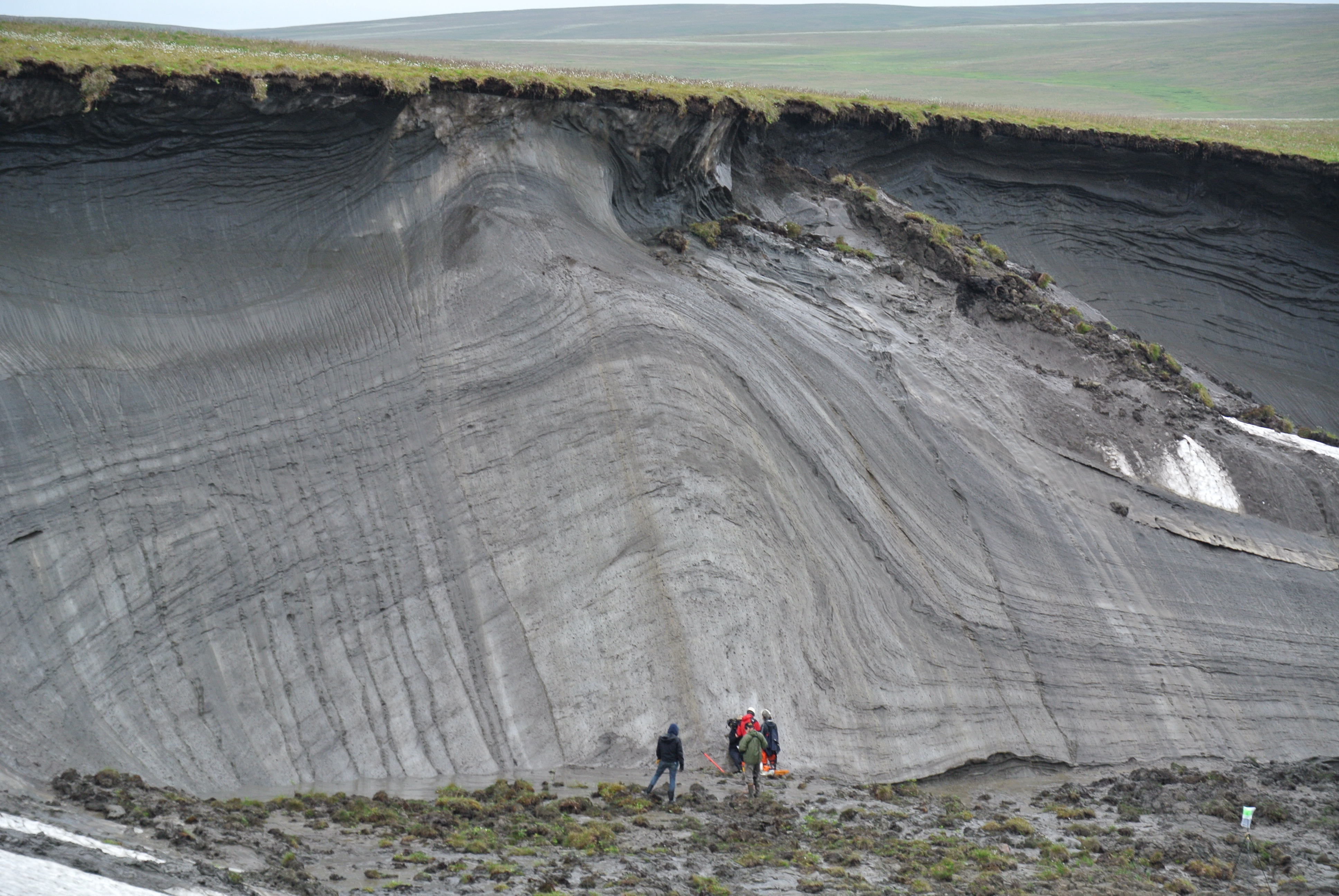 Thawing permafrost in Herschel Island, by Boris Radosavljevic (2013)
In my job market paper, I examine how environmental degradation in resource-dependent communities affects rural-urban migration choices, and then use variation in the world’s longest-running universal cash transfer (The Alaska Permanent Fund Dividend) to show how liquidity constraints impede this adaptive migration.